

Shuttle Racking System: Advantages and Disadvantages (2026 Guide)
If you are comparing warehouse racking systems for a new facility—or trying to squeeze more pallets into an existing one—the semi-automated shuttle racking system is probably on your shortlist, right next to conventional selective pallet racking and drive-in racking.
The problem: shuttle racking is often sold with a one-sided pitch. Suppliers highlight the storage density and stay quiet about the trade-offs. This guide gives you both sides, so you can decide whether the investment actually fits your operation.
At Nesrack, we design and manufacture pallet racking, shuttle racking, drive-in racking, and mezzanine systems as a factory-direct supplier, and we prepare a free 3D layout for every serious inquiry. The guidance below comes from real projects, not brochures.
What Is a Shuttle Racking System?
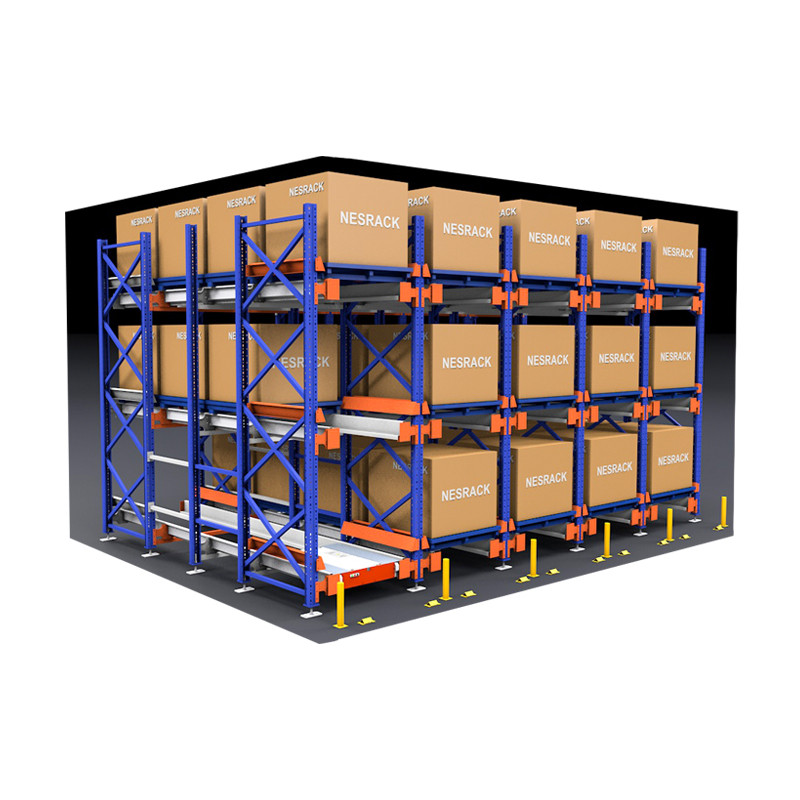
A shuttle racking system combines high-density racking with a battery-powered shuttle cart that runs inside the racking lanes on rails. Instead of a forklift driving into the rack, the forklift places a pallet at the lane entrance, and the shuttle carries it deep into the system.
This removes the forklift from the storage lanes entirely, which is the source of both shuttle racking's biggest advantage (density) and its main disadvantage (equipment dependency).
Key components:
Racking structure: heavy-duty uprights and beams, similar to standard pallet racking but with rail supports
Shuttle cart(s): radio-controlled, battery-powered, with onboard sensors and lifting tables
Rails/track channels in each lane
Remote control or tablet interface, and optionally a fleet of shuttles coordinated by WMS software
Advantages of Shuttle Racking
1. Highest storage density of the "forklift-entry" alternatives
Selective racking typically achieves 30–40% usable storage footprint because every pallet needs its own aisle-facing position. Drive-in racking improves this to around 60–70%. Shuttle racking reaches 70–85%, because lanes can go 5–10 pallets deep with no entry gap for a forklift.
For a warehouse where land or rent is expensive, this is the single strongest argument.
2. Far less forklift labor and lower collision risk
In a selective system, every retrieval means a forklift entering a rack-side aisle—drivers spend most of their shift driving, and rack uprights take constant hits. Shuttle systems concentrate forklift work at the front face: load, release, retrieve. Many operators report **20–30% lower forklift operating hours** and dramatically less rack damage, which also means fewer repair costs and fewer safety incidents.
3. FIFO and LIFO without rebuilding the rack
Unlike drive-in racking, where LIFO is basically forced by the geometry, shuttle systems support both:
LIFO for fast-moving, single-SKU lanes (common in food and beverage distribution)
FIFO by using through-style lanes with entry points on both ends
If your inventory rotation strategy may change, shuttle is the flexible high-density option.
4. Semi-automation at a fraction of AS/RS cost
A full automated storage and retrieval system (AS/RS) can cost several million dollars and requires a purpose-built building. A shuttle system delivers a meaningful share of that productivity—less driving, fewer errors, higher throughput per shift—for roughly the price of racking plus carts. It is also **scalable**: start with one shuttle, add more as volume grows.
5. Better picking throughput for single-SKU-heavy operations
If your operation moves pallets in full-pallet quantities (beverage, food processing, cold storage, 3PL bulk storage), the shuttle's constant travel speed inside lanes makes throughput predictable and fast, especially at peak times when aisles in a conventional warehouse congest.
6. Suitable for cold storage and harsh environments
Because humans and forklifts don't enter the lanes, shuttle racking works well in freezers and cold rooms where labor time is expensive and forklift maneuvering is risky. This is one of the most common shuttle use cases we design for.
Disadvantages of Shuttle Racking
1. Higher initial investment than selective or drive-in
Shuttle racking costs more upfront than selective racking—typically 30–60% more on the racking itself, plus the cost of shuttle carts. For a small warehouse with low pallet volume, the payback period may simply be too long. **Shuttle racking pays for itself through volume; below roughly 1,500–2,000 pallet positions, the math rarely works.**
2. Dependency on shuttle equipment
Your storage system is only as good as the carts running in it. A failed shuttle stops an entire lane. You need:
- Spare parts and a service plan (ask the supplier before you buy)
- Charging stations inside the warehouse
- Trained operators—shuttles are simple, but they are still equipment
Factory-direct suppliers who stock spare shuttles and parts locally solve most of this risk; brokers who disappear after installation do not.
3. Strict pallet quality requirements
The shuttle lifts pallets from below. Broken, non-standard, or sagging pallets cause jams and damage. If your operation mixes GMA pallets with imported one-way pallets of varying condition, you will need to either standardize pallets or accept occasional manual intervention.
4. Not ideal for high-SKU, low-volume picking
Shuttle lanes hold one SKU per lane in most configurations. If you store thousands of SKUs with only a few pallets each, deep lanes waste space and selective racking remains the better answer. Shuttle shines when you have **few SKUs, many pallets per SKU, and high throughput**—the opposite profile of a piece-picking e-commerce warehouse.
Shuttle vs. Selective vs. Drive-In: Quick Comparison
So, Is Shuttle Racking Worth It?
Shuttle racking is worth the investment when most of these are true:
- You have (or plan) 1,500+ pallet positions
- Your inventory concentrates in **a limited number of SKUs with deep stock per SKU**
- Land/rent costs or expansion limits make density valuable
- You move pallets at high volume daily (food, beverage, cold chain, 3PL bulk)
- You want semi-automation now, with a path to more later
It is probably *not* worth it if you run a high-SKU operation with shallow stock per SKU, if your pallet quality is inconsistent, or if your current volume doesn't justify the equipment.
Get a Free 3D Layout Before You Decide
The honest way to compare systems is to put them side by side on *your* floor plan. Send us your warehouse dimensions (length × width × clear height), pallet size, and daily pallet movement, and our engineers will prepare a free 3D layout comparing selective, drive-in, and shuttle options for your building—usually within 48 hours.
No obligation, no sales pressure. Just the numbers.
[Request your free 3D warehouse layout →]
RELATED POSTS
ONLINE MESSAGE